
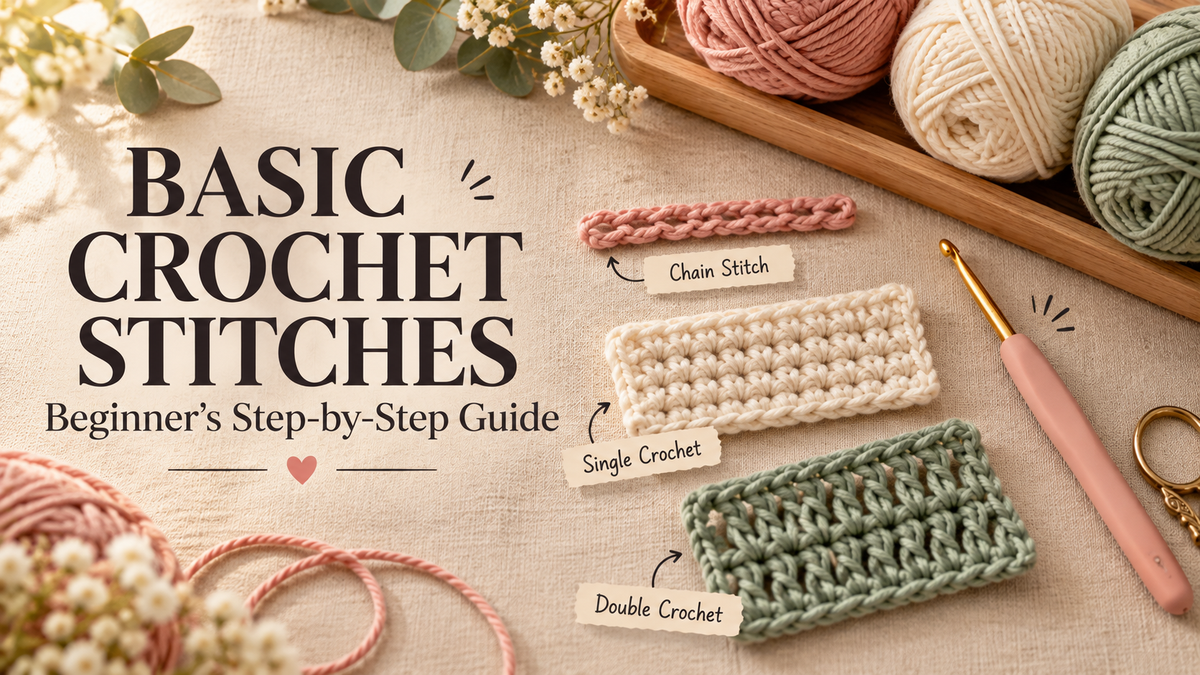
Quick answer: The most useful basic crochet stitches for beginners are the chain (ch), slip stitch (sl st), single crochet (sc), half double crochet (hdc), double crochet (dc), and treble crochet (tr). Once you can make those stitches, you can follow many beginner crochet patterns. The magic ring is another useful technique, especially for amigurumi. All instructions below use US crochet terminology.
What do you need to learn crochet?
Start with one 5 mm crochet hook, light-colored smooth medium-weight yarn, scissors and a yarn needle. A few stitch markers are useful for counting. Choose a yarn that does not split easily and leave fuzzy or plush yarn until you can see and identify your stitches. For a detailed explanation of sizes and materials, see our crochet hooks for beginners guide.
Basic crochet stitch abbreviations (US vs UK)
| Technique | US abbreviation | UK equivalent |
|---|---|---|
| Chain | ch | ch |
| Slip stitch | sl st | sl st |
| Single crochet | sc | double crochet (dc) |
| Half double crochet | hdc | half treble (htr) |
| Double crochet | dc | treble (tr) |
| Treble crochet | tr | double treble (dtr) |
Important: US and UK stitch names differ even though the techniques are equivalent. Always check which terminology your pattern uses before starting.
1. Chain stitch (ch): the foundation
The chain stitch creates the starting foundation for many projects and also forms turning chains and spaces between stitches.
- Make a slip knot and place it on your hook, leaving the loop loose enough to slide.
- Bring the working yarn over your hook from back to front (yarn over).
- Pull that yarn through the loop on your hook. You have made one chain stitch.
- Repeat until your foundation chain is the requested length. Do not count the slip knot as a chain.
Beginner tip: Count the V-shaped links across the front of your chain. Keep them even rather than tight and twisted.
2. Slip stitch (sl st): joining and moving
Slip stitches are among the shortest crochet stitches. Use them to join rounds, create neat edges and move your hook across stitches without adding height.
- Insert your hook into the indicated stitch.
- Yarn over.
- Pull the yarn through both the stitch and the loop already on your hook in one motion.
Common mistake: Pulling slip stitches too tight makes it difficult to insert your hook on the next round.
3. Single crochet (sc): a firm beginner stitch
Single crochet makes a short, relatively dense fabric and is commonly used for amigurumi toys, baskets, coasters and simple accessories.
- Insert your hook into the next stitch.
- Yarn over and pull up a loop. You now have two loops on your hook.
- Yarn over and pull through both loops. One single crochet is complete.
Practice: Make a foundation chain of 16, work single crochet in the second chain from the hook and across, for 15 stitches. Chain one and turn as instructed by your pattern. Count every completed row to catch accidental increases or decreases.
4. Half double crochet (hdc): soft and versatile
Half double crochet sits between single and double crochet in height. It creates fabric with a gentle texture, making it useful for hats, cozy accessories and blankets.
- Yarn over before inserting your hook into the next stitch.
- Yarn over and pull up a loop. You should have three loops on the hook.
- Yarn over and pull through all three loops.
Tip: Keep your yarn-over motion consistent to avoid loops slipping from the hook.
5. Double crochet (dc): taller and quicker to build
Double crochet is a widely used stitch in granny squares, blankets, garments and open lace designs. Its greater height creates a drapier fabric than single crochet with the same yarn.
- Yarn over, then insert the hook into the indicated stitch.
- Yarn over and draw up a loop (three loops on hook).
- Yarn over and pull through the first two loops (two remain).
- Yarn over again and pull through the final two loops.
Tip: For foundation-row practice, follow the pattern's turning-chain instructions, because whether a turning chain counts as a stitch varies by pattern.
6. Treble crochet (tr): extra height and drape
Treble crochet is taller than double crochet and is commonly used in lacy patterns and textured motifs.
- Yarn over twice before inserting your hook.
- Insert into the next stitch, yarn over and pull up a loop (four loops).
- Yarn over and pull through two loops (three remain).
- Yarn over and pull through two loops (two remain).
- Yarn over and pull through the last two loops.
Work slowly at first so the tall stitch does not become loose or uneven.
7. Magic ring: a useful amigurumi technique
A magic ring is not technically a stitch, but it is a valuable starting method for crocheting circles and stuffed animals without leaving a large central hole.
- Loop your yarn to make an adjustable circle, leaving a tail.
- Insert the hook through the loop, draw up the working yarn and secure it with a chain where the pattern directs.
- Crochet the required stitches into the open ring, typically single crochet.
- Pull the tail slowly until the center closes. Secure the tail according to your pattern.
Practice with a simple circle before trying a small amigurumi crochet pattern.
How do you read a basic crochet pattern?
Patterns use abbreviations, repeat symbols and stitch counts to keep instructions compact. For example, “R1: 6 sc in MR [6]” means round one contains six single crochets worked into a magic ring, with six stitches total. “(sc, inc) × 6 [18]” usually means repeat one single crochet and one increase six times, yielding eighteen stitches. Always read a pattern's abbreviation key, as designers can define their own notation.
Which crochet stitch should you learn first?
Learn chain stitch first, then single crochet. After you can make a square with even edges, practice slip stitch, half double and double crochet. Move to treble crochet and the magic ring when ready. This order progresses from forming a foundation to controlling stitch height and crocheting in the round.
Beginner crochet mistakes and quick fixes
- Your edges keep shrinking: Count stitches at the end of every row; you may be missing the last stitch.
- The fabric is too tight: Relax your yarn grip or test a slightly larger hook.
- Your fabric is too loose: Practice consistent tension, or use the hook size recommended by your pattern.
- Stitches twist unexpectedly: Check that you are working into the correct loop and turning consistently.
- The pattern looks different: Confirm US versus UK stitch terminology and whether turning chains count as stitches.
Three easy practice projects using basic stitches
Practice coaster: Work rows of single crochet into a square and finish with a simple border. Beginner scarf: Repeat rows of half double crochet in your favorite yarn. Small granny square: Practice groups of double crochet and chain spaces once you are ready to work in rounds. Find more inspiration in the AssetMira crochet patterns collection; check each listing's material requirements before choosing a project.
Frequently asked questions
What are the six basic crochet stitches?
The commonly taught six are chain, slip stitch, single crochet, half double crochet, double crochet and treble crochet, using US stitch names.
Is single crochet easier than double crochet?
Single crochet uses fewer steps and is often taught first. Double crochet is taller and takes a little more coordination, but many beginners learn it quickly with practice.
What crochet stitch is best for a beginner blanket?
Single crochet makes a sturdy, dense blanket; half double crochet adds softness and drape; double crochet builds fabric more quickly. The best choice depends on the texture you want.
What does sc mean in crochet?
In US terminology, sc stands for single crochet. In UK terminology, the equivalent stitch is called double crochet.
How many chains do I need to start crocheting?
There is no universal number. Make enough chains for the width of your practice piece or follow your pattern's foundation-chain instructions.
Do turning chains count as stitches?
Sometimes. This depends on the stitch and the designer's instructions. Check whether your pattern tells you to count the turning chain as the first stitch.
Ready for your next project?
You do not need to master dozens of stitches to make beautiful crochet projects. With the six foundations above and a little practice, you can start exploring granny squares, coasters, cozy accessories and amigurumi. Browse digital crochet patterns at AssetMira and revisit our crochet hook size guide whenever you need help choosing tools.


Comments
0 published · New comments are reviewed before appearingJoin the conversation
Your comment will be reviewed before it appears publicly.